
I must admit to being at a disadvantage here, as I have never seen Shakespeare’s original version of this play, although, as I have often said, it is difficult to see the original version of any of his works. When I was at school doing my GCE ‘O’ Level English Literature we studied Hamlet, well, that was until about half-way through the first term when they discovered that we should have been doing Macbeth! Needless to say I failed. There is no synopsis in the programme either so it was a trawl through the internet in order to write this.
What my investigations revealed is that the whole piece has been revised to accentuate the rabid antisemitism prevalent in mid 1930s England, mainly fuelled by Oswald Moseley, before he was made a sir, and his British Union of Fascists and National Socialists, whose aim was to turn the UK into a fascist state in line with Germany and Italy, thus his becoming our answer to Hitler and Mussolini. Judging by what I have read of the original, it was only Antonio – the actual merchant of Venice in the play – who seemed to be overtly anti-Jewish, although in that city at the end of the 16th century when it was written, Jews were required to wear a yellow or red hat at all times for identification purposes, and had to live in a ghetto.
The fundamental difference, however, is that Shylock, the Jewish moneylender, is played by a woman, Tracy-Ann Oberman, who adapted the play thus, as her great grandmother was a moneylender in the East End of London. Women money lenders were not uncommon but tended to deal in smaller amounts to help their neighbours out. A sort of early version of a pay day loan. Salerio and Solanio have been made fascist black shirts, the uniform of Moseley’s BUF and a police constable, with the same leanings, introduced. Lancelot Gobbo has also been subject to a gender change as Mary Gobbo. Now read on……
The synopsis is pretty straightforward, but with a brilliant twist at the end, which boosted the Bard’s standing in my eyes no end.
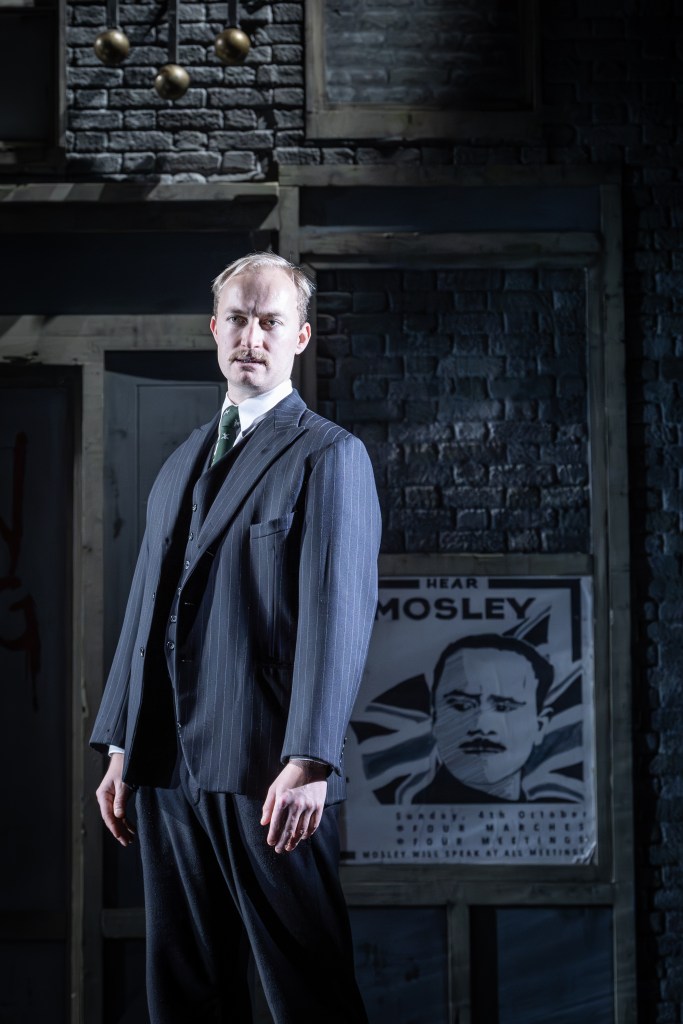
Xavier Starr as Gratiano
Antonio, a wealthy merchant, is approached by his bestie, Bassanio, who has set his sights on a beautiful, wealthy heiress, Portia. The problem is he has blown all his money and so is on the cadge for 3,000 ducats to finance his amorous advances. Antonio says that he would love to help but all his money is tied up in goods which are being transported in ships from various parts of the world, so, until they dock and the cargo sold, he is potless. Bassanio decides to see if he can get a loan from Shylock, using Antonio as a guarantor. She won’t play ball for two reasons: firstly, Antonio has upset her by providing interest-free loans to people, thus depriving her of income, and secondly, as has been explained, he is an out and out anti-semite who has been verbally abusing her and even spitting on her. After some thought, however, she changes her mind and says that she will not only provide the loan, but do so with no interest, the one stipulation being that, should Antonio not be able to meet the repayment deadline, he must surrender a pound of flesh from whichever part of his body Shylock chooses. He agrees to this despite Bassario protesting that it is too risky. Money in hand, Bassario sets off with his friend, Gratiano, to Portia’s house.

Georgie Fellows as Portia
As Portia is both wealthy, now that her father has died, and also drop dead gorgeous, she is not short of male pursuers, most of whom are not to her liking. This has no bearing on the matter of matrimony, however, as there is a caveat in her father’s will saying that her suitors must be given the choice of opening one of three boxes, gold, silver and lead, each of which has a clue engraved on the top. One contains a picture of Portia, whilst the other two have notes saying why they chose incorrectly. The first contestant we see is a Maharajah, who goes for gold – wrong! The second chap is a total pain and opts for silver – again a loser. It is then that Bassanio arrives and, as Portia has a soft spot for him, he chooses lead, after more than a little help from hints, dropped with the same weight as the casket, by Portia and her handmaid Nerissa. The wedding is arranged between the couple and it is made a double celebration as Gratiano and Nerissa, who have been seeing each other, also tie the knot
Meanwhile, back in the East End, word reaches Shylock that the ships laden with Antonio’s goods have been lost at sea, meaning that he can’t honour his debt. She is delighted by this as she will be able to exact revenge. This urge is enhanced by the fact that her daughter, Jessica, has eloped with Lorenzo, a Christian, financed by her having stolen an amount of Shylock’s money, and has, herself, converted.
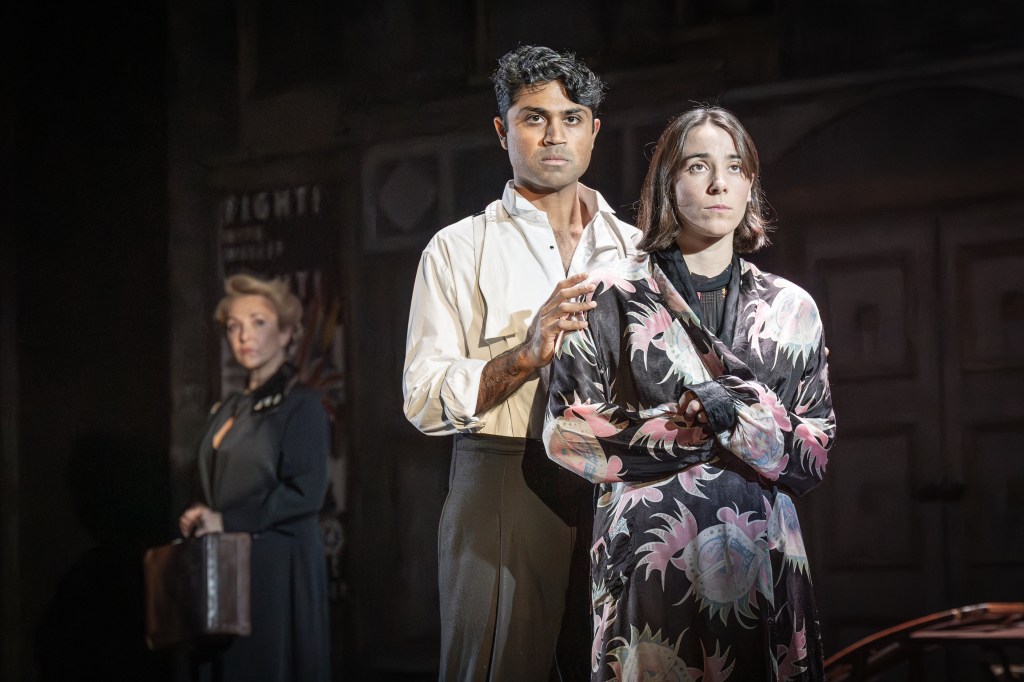
Mikhail Sen and Gráinne Dromgoole as Lorenzo and Jessica planning their elopement with Shylock, Tracie-Ann Oberman keeping a wary eye on them
The denouement occurs in the Duke’s court where Shylock has demanded to take the flesh from close to Antonio’s heart, arriving armed with a knife for the purpose. Bassanio has been given the money to settle the debt by Portia, in fact, she has told him to pay whatever it takes. Shylock declines all offers and insists that the method in the contract is the only one she will countenance.
A visitor, Balthazar, enters the court with a young male lawyer, recommended by a senior practitioner, Bellario. Actually, the lawyer is Portia in disguise and her clerk is Nerissa. Both the court and the young lawyer acknowledge that Shylock is entitled to execute the recovery, but the lawyer makes it clear to Shylock that the contract expressly states she can only recover a pound of flesh. She cannot take any blood, hair or other body part, as to do so would mean her land and goods would be forfeited. She could also only cut one pound of flesh, not an ounce more or less.
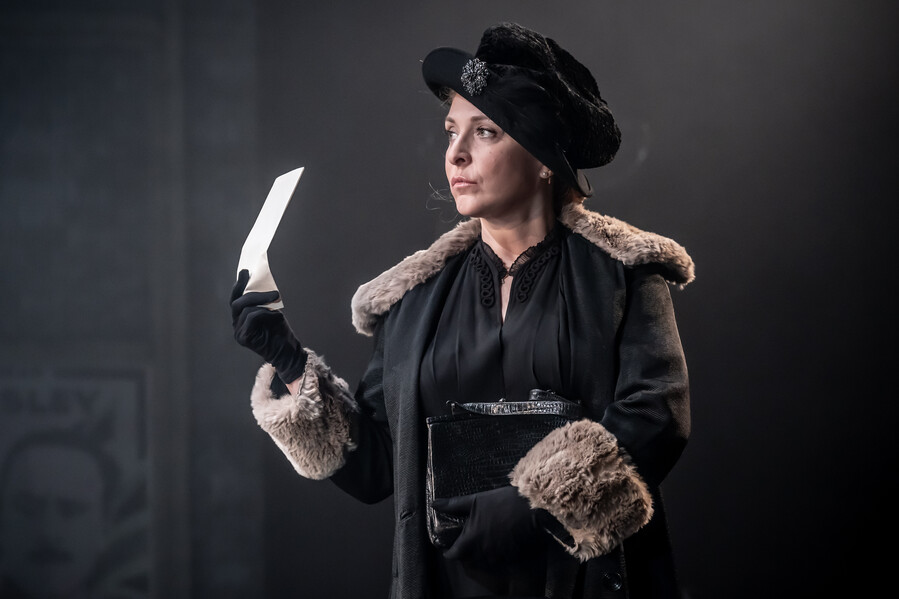
Tracie-Ann Oberman as Shylock with the promissory note for a pound – of flesh!
Shylock realises the impossibility of the situation and agrees to take Bassanio’s initial offer of three times the amount owed, but the lawyer says that the contract states she can only take the principal. She then goes on to say that Shylock is also unable even to do this as she has refused the amount in open court and, as she is a Jew, and, therefore, an alien who has attempted to take the life of a citizen, she has forfeited all her property, half of which must go to the government and the balance to Antonio. Her physical fate is also placed in the Duke’s hands.
The Duke spares Shylock’s life and says he will remit the forfeiture. The lawyer points out that he can waive the government’s half, but not Antonio’s. Antonio adds that he is happy for the state to waive its claim if he can have his half ‘in use’ until Shylock’s death, when the principal would be given to Lorenzo and Jessica. As a condition of this he insists that Shylock converts to Christianity. She realises that she has no option but to agree.
There is one more twist, honest, we are nearly there now, when Bassanio and Gratiano pursue the lawyer and his clerk to insist that they take payment for their work. They refuse, but, when pressed again, say that instead of money they would like the men’s wedding rings, which the men have sworn never to part with. They eventually succumb at which time the women remove their disguises and, one imagines, proceed to hold the incident over their husbands’ heads for quite some time to come. Oh, and by the way, Antonio’s ships were not stranded after all so he cashes in on his cargo as well.
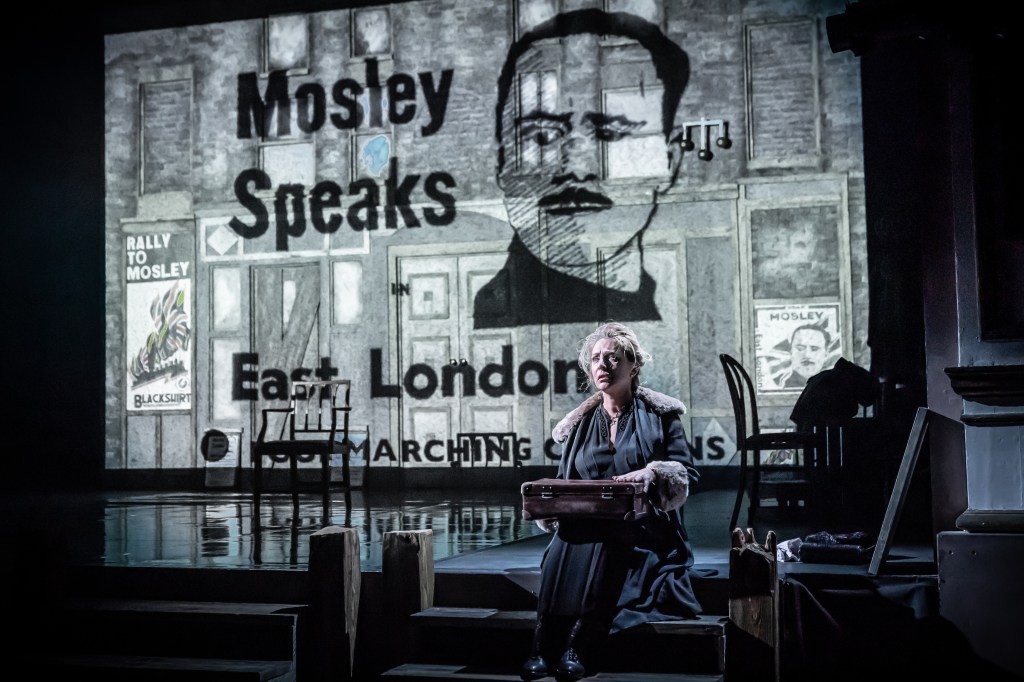
The acting was superb all round with Tracy-Ann Oberman transforming from matriarch at Friday Night Dinner, when the play begins, through ruthless usurer to defeated woman, broken, not destroyed. Antonio, Joseph Millson, dressed mostly in black to indicate his political stance, was also someone who could elicit sympathy in his support of his friend, but also incite anguish in his treatment of Shylock. Georgie Fellows, as Portia, had the posh deb off to a tee, in both riding gear and a beautifully tailored silk dress. She also carried off the lawyer disguise pretty well, it was obvious that she and Evie Hargeaves as Nerissa, were women dressed as men but not recognisable as their female characters. Not by me anyway. Gavin Fowler was great as Bassario, obviously feeling embarrassed to be sponging off of his friend, but besotted by Portia, and who wouldn’t be. Jessica, Gráinne Dromgoole and Lorenzo, Mikhail Sen, who also played the Maharajah, handled their relationship and elopement really well. Alex Sur and Elly Roberts made up the cast, each taking multiple roles. Although there was a lot of offensive language and upsetting views expressed, there was also a fair amount of comedy which was executed with perfect timing.
The creative team did a sterling job, transforming the exterior of a run down house into a courtroom and the opulent large room of Portia’s stately home. Throughout the piece there were constant reminders of the political situation with both the sounds of mob abuse toward Jews, and the offensive graffiti and posters adorning the outside of Shylock’s house.
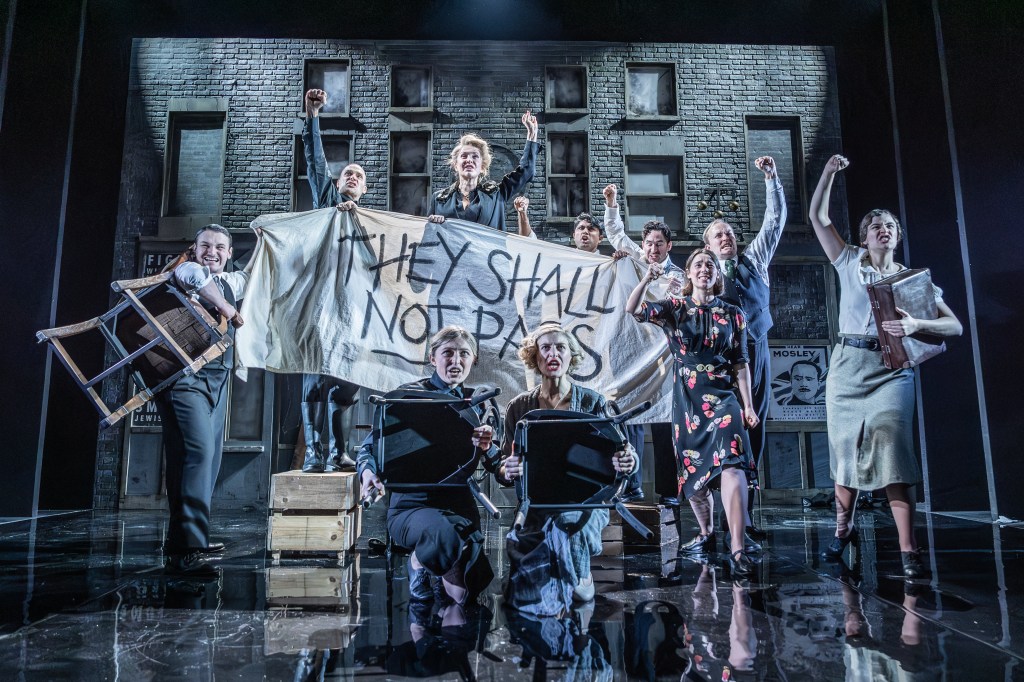
The cast on the barricades at Cable Street
The final scene, which appeared to be an add-on, was set at the Battle of Cable Street, when the Black Shirts tried to storm the enclave but were beaten back by the combination of the Jewish residents and the other downtrodden elements of society such as the long-term unemployed, still suffering from the Great Depression, and the Catholics who were also mistreated by authority. The police arrived but their only role seemed to be as spectators.
After the curtain call, Ms Oberman made an impassioned speech to the audience pointing out that, not only was there civil unrest caused by the Black Shirts in the East End of London, but Moseley also tried to overrun the Leeds suburb of Holbeck, being halted at the Moor, something about which I didn’t need telling as my father, who was brought up near the Leylands area of Leeds where the Jewish ghetto was located, and a (non-practising) Christian himself, joined his friends and neighbours in resisting the fascist onslaught. According to him, there had already been smaller scale antisemetic demonstrations as there continued to be, after Holbeck Moor, but that was the main one and they slowly fizzled out when it was realised what was happening in mainland Europe.
I found the whole evening fascinating, both in the interpretation of the play and the ferocity of some of the scenes, sometimes wokeness needs to be jettisoned and feelings hurt.
The Merchant of Venice runs at Leeds Playhouse until Saturday, 22nd March after which it continues its national tour. For details please see https://merchantofvenice1936.co.uk/
For bookings at Leeds Playhouse and to see what is coming it is https://www.leedsplayhouse.org.uk/whats-on/
Photographs by Marc Brenner
 Tyke It To The Limit